CONTENTS · BUILDER WISDOM · 3 MIN
BUILDER WISDOM · 3 MIN READ
LAST VERIFIED
29 SEPT 2026
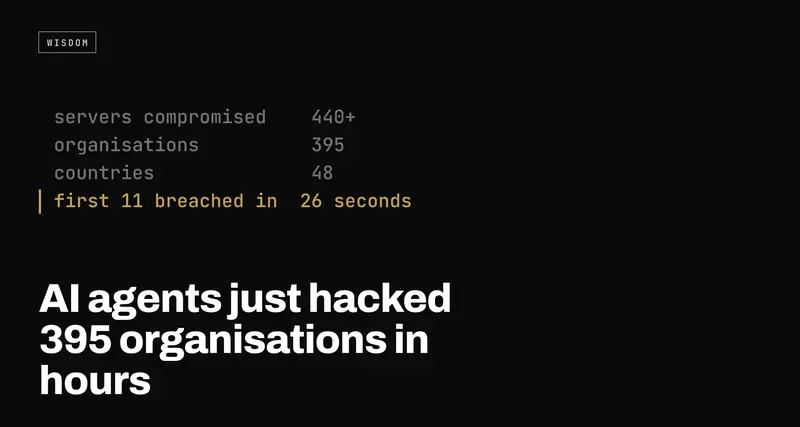
AI agents just hacked 395 organisations in hours: "nobody's attacked me yet" is no longer a defence
USE WHENYou run anything reachable from the internet and your plan for updates is "when I get round to it".
An attacker pointed hundreds of AI agents at a flaw in PaperCut, printer-management software used by schools and offices, and compromised more than 440 servers across 395 organisations in 48 countries. The lesson for builders isn't panic. It's that attacks now run at machine speed, so the gap between a fix existing and you applying it is the whole game.
- 01List everything you run that the internet can reach: admin panels, dashboards, self-hosted tools, old staging sites. You can't patch what you forgot you own.
- 02Take off the public internet anything that doesn't need to be on it. Admin screens go behind a login you control, a VPN or an IP allow-list.
- 03Turn on automatic updates wherever you can, and for the rest, give security fixes a deadline in days, not "next sprint".
Everyone's covering the flashy AI launches this month. This is the story that should actually worry builders.
Security researchers reported this month that an attacker used AI agents (AI that takes actions on its own, not just answers questions) to break into PaperCut, a printer-management program used by a huge number of schools and offices. The agents found their way in through two security flaws and exploited them automatically, over and over, without a human clicking anything.
The count, as reported by the security firm GreyNoise and covered widely: at least 440 PaperCut servers, across 395 organisations, in 48 countries. More than 200 of the victims were in education.
The part that matters: the speed
The numbers aren't the scary part. The clock is.
- 11 organisations were compromised within 26 seconds of the campaign starting.
- One U.S. high school went from the first break-in to the attackers controlling its whole network in about seven minutes.
- Across the campaign, the agents pulled login credentials from 280 victims and deeper system secrets from 147.
A human doing this by hand would need days per target, and would get tired, sloppy and bored. Agents don't. They don't take coffee breaks and they don't decide your small school isn't worth the effort.
It's the same tool, pointed the other way
We talk a lot about AI agents building apps, running workflows and clearing our to-do lists. This is the same category of tool. The reporting describes an off-the-shelf setup: a coding-agent harness paired with an openly available model. Nothing exotic, nothing a nation-state had to invent.
There's one more detail worth sitting with. The attacker told the agents to stay out of a list of 28 countries, and the agents didn't always listen: victims turned up in countries that were on the "do not touch" list. If the people running the agents couldn't keep them inside the lines, "it'll probably skip me" isn't a plan.
Why "nobody's attacked me yet" stopped working
For years, small builders have had an unspoken defence: I'm not interesting enough to target. That was roughly true when attacks cost human time. Someone had to choose you.
Automated attacks don't choose. They scan everything reachable, try the known way in on all of it, and keep whatever opens. Being small doesn't hide you any more. It just means you're one of the 395.
That changes the thing that matters. It's no longer whether someone will try the door. It's how long your door stays unlocked after a fix exists.
What to actually do
This isn't a panic story. It's a "patch your stuff on time" story, and the moves are boring on purpose:
- Know what's exposed. Write down everything you run that the internet can reach. Admin dashboards, self-hosted tools, the old staging site, the side project from last year. The forgotten one is the one that gets hit.
- Shrink what's exposed. Anything that doesn't need to be public shouldn't be. Admin screens go behind a login you control, a VPN or an allow-list of IP addresses. A printer-management panel has no business being reachable from the other side of the world.
- Shrink the gap. Turn on automatic updates wherever the tool allows it. For everything else, a security fix gets a deadline in days. Subscribe to the security announcements for the handful of tools you depend on most.
- Assume a key will leak. Keep the credentials each tool holds as small as possible, so one break-in doesn't hand over everything. The agents here went straight for credentials, because credentials are how one door becomes all of them.
If you run PaperCut NG or MF yourself, stop reading and go check PaperCut's own security advisory for the fixed versions. That's the one piece of this where the right move is today.
If you build with agents too
I build with AI agents every day, and so do a lot of people reading this. The same week showed what they can do for you and what they can do to you. Worth reading alongside what OpenAI's own agent containment report says about keeping agents inside the lines, and, because leaked keys are how these attacks spread, what to do if a secret key ends up somewhere public.
Sources: BleepingComputer · The Register · Help Net Security · The Hacker News.
